Dental X-rays: when they are needed and what they show
A dental X-ray can reveal things that a check-up alone cannot show. Learn when imaging helps, how the right type is selected and what to tell your dentist.
Key takeaways
- Imaging complements an examination and answers a specific clinical question.
- A new X-ray is not needed at every dental visit.
- Panoramic X-rays and CBCT are not interchangeable examinations.
- Bring previous images and mention any possibility of pregnancy.
“Can’t we just look at the tooth?” Sometimes an examination is enough. At other times, the useful information is between the teeth, around a root or in the bone. An appropriate dental X-ray can then help guide the next step.
What does an X-ray add to an examination?
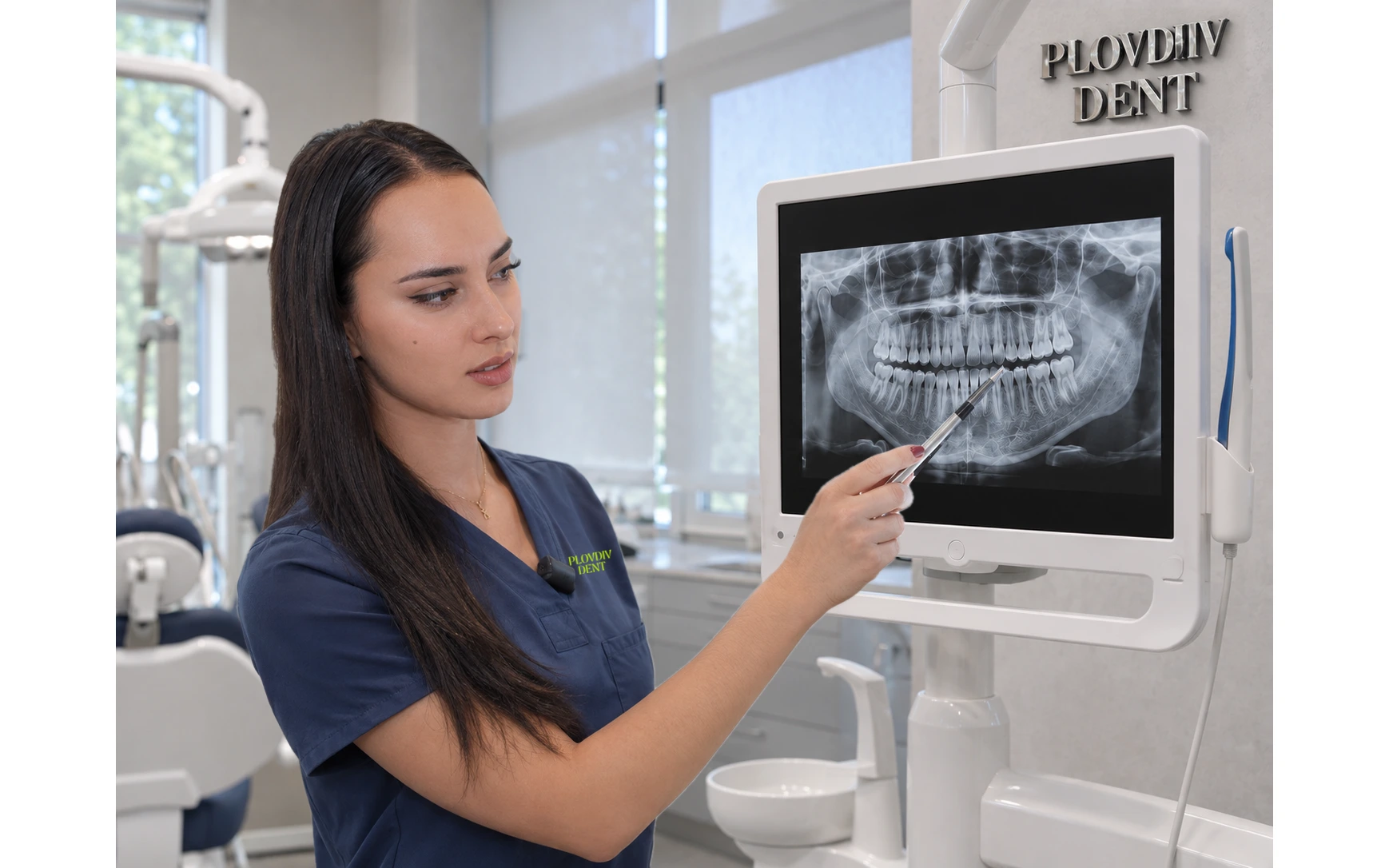
Imaging can help identify hidden decay, assess the supporting bone, show changes around roots or locate an unerupted tooth. It can also support the planning or follow-up of particular treatments. Images are interpreted alongside your symptoms, history and examination: a picture alone cannot necessarily explain every toothache.
A small dental X-ray, a panoramic image or 3D imaging?
- A small intraoral X-ray provides targeted information about particular teeth and a selected area. The type depends on the clinical question.
- A panoramic X-ray gives a broader view of the teeth and jaws. It helps assess their overall position, but does not replace every detailed image.
- Cone-beam computed tomography — CBCT provides three-dimensional information. It may be needed for specific planning when a simpler examination cannot answer the question adequately. It is not a routine “just in case” test.
More images do not automatically mean better care. The aim is to obtain the information needed using an appropriate examination.
Do I need a new X-ray at every visit?
No. There is no single interval for everyone. The decision depends on your current oral health, age, risk, symptoms and planned treatment. Bring previous images or an accessible copy. Your dentist can check whether they show the right area clearly enough and still reflect your condition. Moving to a new practice does not automatically mean having new X-rays.
How is safety considered?
X-ray examinations use ionising radiation. The choice and settings should suit the clinical need and the patient, while unnecessary repeat examinations are avoided. CBCT generally involves more radiation than a conventional dental X-ray, so there should be a specific reason to request it. Digital does not mean “radiation-free”.
Children’s imaging needs particularly careful assessment, with the examination adapted to them. Tell the team before imaging if you are pregnant or might be pregnant. They can discuss the need, timing and suitable approach with you. Please do not put off a necessary dental assessment simply because you are worried about imaging.
Earliest available appointment
Checking the schedule…
What can I ask before the examination?
You are welcome to ask: “What are we looking for?”, “Why this type of image?” and “Could my previous images help?”. Mention a strong gag reflex or difficulty keeping still. The team will explain positioning and which items need to be removed. At Plovdiv Dent, we start with a conversation and examination so that the next step is chosen thoughtfully.
Frequently asked questions
Do I need an X-ray if nothing hurts?
A lack of pain does not rule out a problem. Imaging is requested when the examination and individual risk indicate that more information is needed.
Is a panoramic image enough for everything?
No. It gives an overview, but a particular tooth may require a different examination.
Does everyone need a 3D scan?
No. CBCT is considered for a specific question when simpler imaging is insufficient.
Can I use an older X-ray?
Bring it along. Your dentist will assess its quality, coverage and relevance to your current condition.